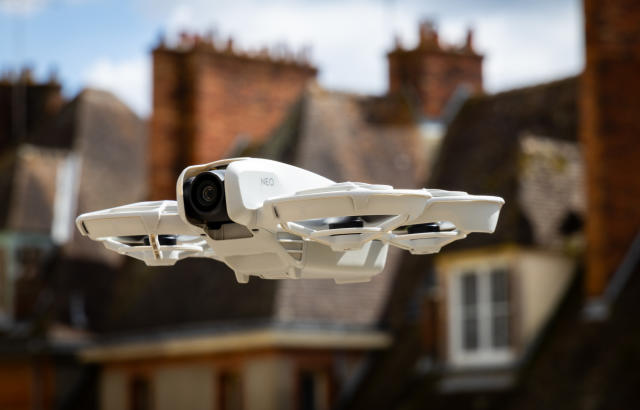
Considering the global shutter on Sony’s A9 III and some great mirrorless options — the Fujifilm X100 VI, Panasonic S9 and Canon EOS R5 II — 2024 was a dull year for cameras, with minor changes and minor improvements. Except for DJI’s Neo. At $200, aerial photography is now within reach of almost everyone.
DJI’s very good, but not so good year
DJI released its product lineup this year with a sword of Damocles hanging over it: The US government was planning to ban sales of the company’s products by the end of 2024 over potential fears of espionage. It was only at the last minute that DJI got a reprieve, thanks largely to lobbying by public safety groups that rely heavily on its drones. It now has until the end of 2025 to prove that its products don’t pose a risk.
The company’s 2024 list of camera gear started with the Avata 2, an FPV drone that improved almost everything from the popular original at a lower price. Then DJI announced its $299 Mini 4K. We also saw the Action 5 Pro, which is DJI’s best action camera yet, as well as the Air 3S, an extremely capable drone with a relatively large 1-inch sensor camera, and the Mic Mini, an affordable wireless mic system.
Its biggest launch, however, was the Neo drone, announced in September. It took the idea of a simple drone for creators that Snap first introduced (then abandoned) with the Pixy, while lowering the price and adding AI technology.
The Neo is a very lightweight drone that can be flown without a license and is safe for people thanks to its covered propellers. It’s ready to use for beginners straight out of the box without any training – just put it in your hand and press a button, then it will fly and capture great programmed shots just like the “dronies”.
Just because the Neo is accessible doesn’t mean it’s basic. If you want to manually pilot the Neo, it supports DJI’s controller, FPV goggles and can also be flown using a smartphone. It can reach speeds of up to 18 MPH or more in manual mode and is easy to steer. Thanks to the built-in AI feature, it can track you while you’re walking or biking, making it a vlogger’s best friend. Finally, it can capture all your footage at 4K 30p, which is surprisingly good quality considering the price.
My biggest gripe with the Neo is that it produces a banshee-like sound, which can be difficult in public places. Overall, though, it’s an extremely useful product at a great price and managed to capture the zeitgeist like no other camera product this year.
Canon and Fujifilm were best of the rest
My favorite mirrorless camera this year was Canon’s EOS R5 II. That’s not because of any spectacular new technology, but due to the fact that it’s a nearly perfect hybrid camera.
It starts with a new 45-megapixel stacked sensor that offers a blend of speed and resolution we’ve only seen so far on Sony’s A1 or the Nikon Z9 – both of which are considerably more expensive. It also has the company’s most advanced AI autofocus system.
All of this allows for ultra-fast shooting speeds of up to 30fps in RAW mode. Its advanced AF system makes blurry photos a rarity even at those speeds. Plus, the 45-megapixel photos deliver exceptional detail and a relatively high dynamic range, with accurate, pleasing colors.
Plus, it offers incredible video power with 8K RAW shooting at up to 60fps and 4K 120p. Like photos, video quality is exceptional thanks to the new CLog 2 capture that allows for high dynamic range. Beyond all that, the EOS R5 II is a great camera to use, with near-perfect ergonomics.
The other camera I really enjoyed using was Fujifilm’s X100 VI Compact. All the praise this camera got this year was well-deserved, as its simplicity, vintage look, film simulation, and great handling have really put the fun back into photography. Plus, it’s a technical marvel with a high-resolution 40-megapixel sensor, decently fast shooting speeds, stabilization, and solid video specs.
Finally, I think Panasonic’s S9 deserves praise for trying something new. It’s one of the smallest full-frame cameras we’ve ever seen, yet it offers features like 6K video and in-body stabilisation. But the main new trick is the built-in LUT simulation – much like Fujifilm’s X100 VI, but for video. This, combined with the large sensor, makes it an interesting camera.